by Stephen J. King
Part 4 of 4 (final) in “The Mystic Shore: Alternative Spirituality and Modernity in Early Twentieth-Century North Sydney”
The Great Pretender: Vyvyan Deacon and the Abbey of Thelema at Milsons Point
If Frank Bennett represented the serious and initiatory face of Australian occultism, Vyvyan Deacon embodied a more theatrical and performative expression of the same cultural milieu. A psychic medium, lecturer, hypnotist and public personality, Deacon moved within many of the same esoteric networks that linked Sydney’s Spiritualists, Theosophists and occultists during the interwar period. Like Bennett, he was acquainted with figures associated with Theosophy and alternative spirituality, demonstrating once again the interconnected nature of Sydney’s esoteric world.
The relationship between Deacon and Bennett was, however, far from harmonious. Although the two men knew one another and shared an interest in occult matters, tensions emerged when Deacon began presenting himself in ways that suggested authority within organisations connected to Aleister Crowley. Bennett, who possessed legitimate authority within both the O.T.O. and A∴A∴ and had received direct recognition from Crowley himself, appears to have regarded Deacon’s claims with considerable suspicion. Contemporary accounts suggest that Deacon either represented himself as connected to the O.T.O. beyond what Bennett considered legitimate or sought to establish a rival body modelled upon it. The dispute highlights competing understandings of occult authority within Australia’s small esoteric community.
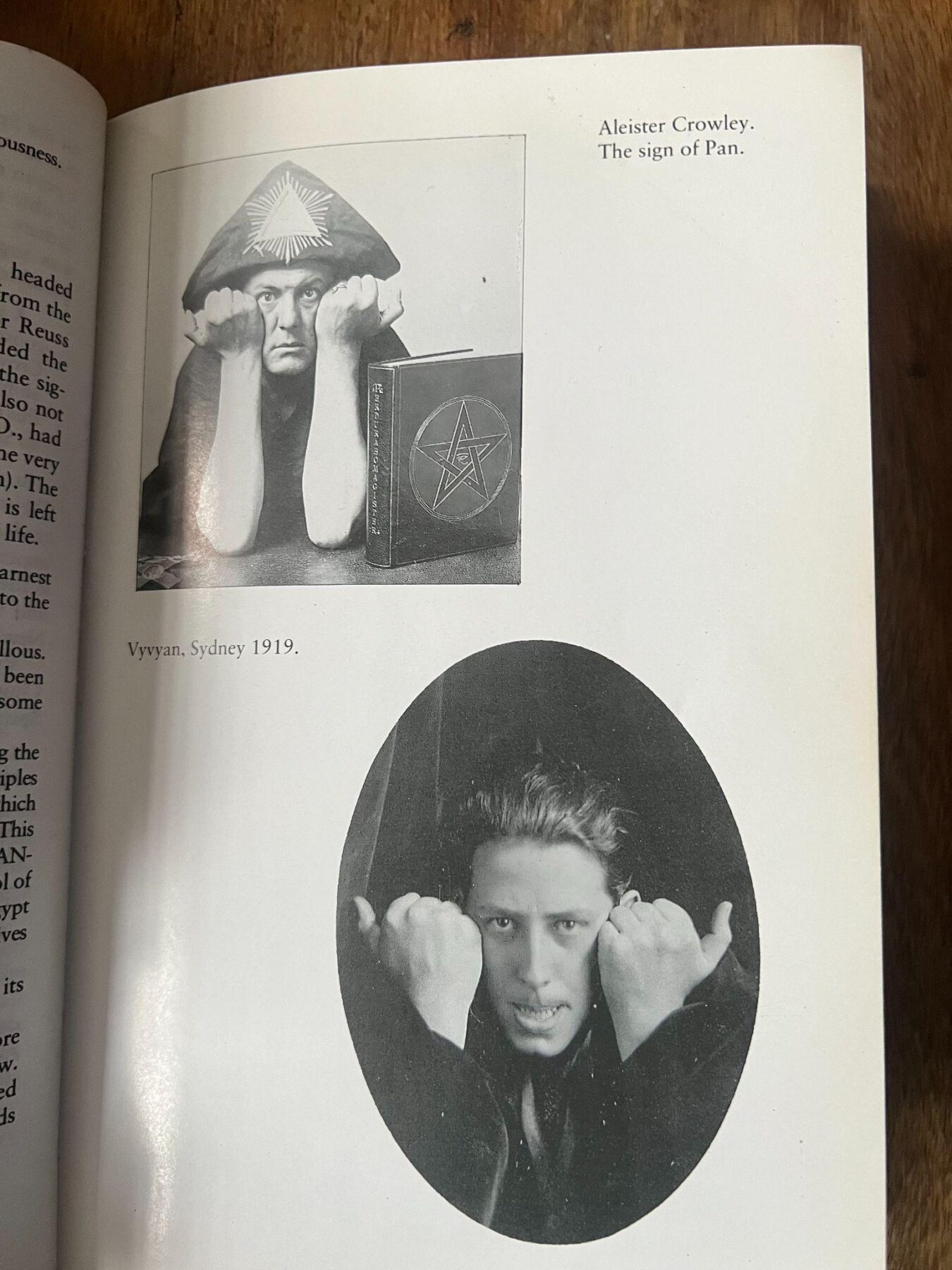
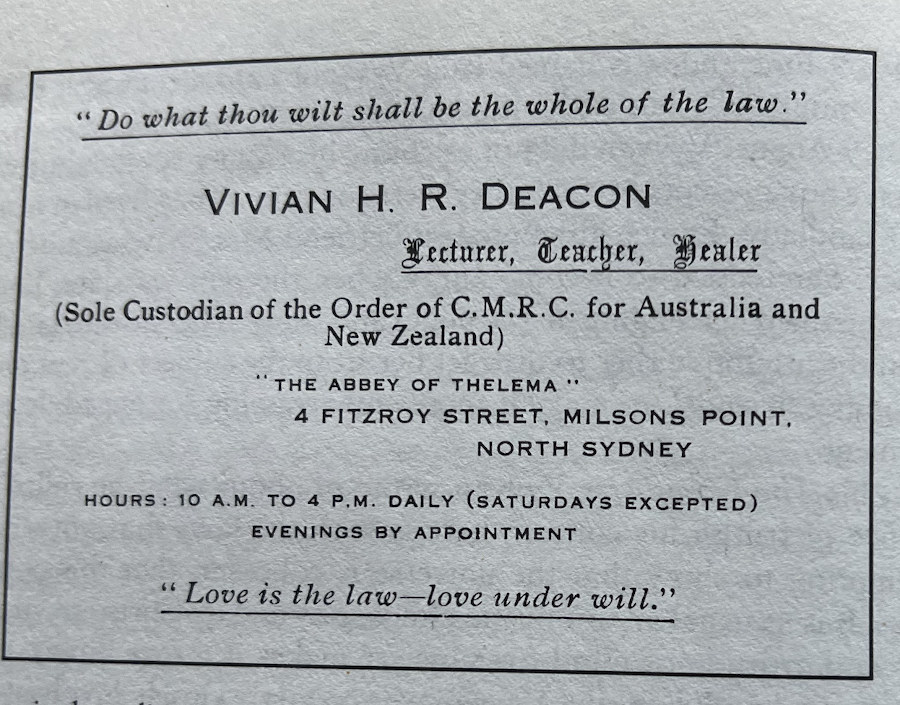
What makes Deacon particularly noteworthy is the extent to which he appropriated the imagery and prestige associated with Aleister Crowley. Whereas Bennett had embraced Crowley’s spiritual philosophy and magical system, Deacon appears to have adopted the Crowleyan persona itself. He imitated Crowley’s photographic style, cultivated an aura of mystery and notoriety, and even established his own “Abbey of Thelema” at Milsons Point, consciously echoing Crowley’s famous Sicilian community at Cefalù. Yet unlike Bennett, there is little evidence that Deacon seriously embraced the central tenets of Thelema, accepted Crowley’s Law of Thelema as a religious philosophy, or undertook the demanding magical disciplines associated with Crowley’s system. His engagement appears to have been largely symbolic, drawing upon the public fascination attached to Crowley’s name rather than the doctrinal content of his teachings.
This distinction reveals an important aspect of occult culture in interwar Australia. Occultism was not a single phenomenon but a spectrum of practices and motivations. For some participants, such as Bennett, it represented a disciplined spiritual path involving study, initiation and personal transformation. For others, occultism offered opportunities for performance, self-fashioning and public notoriety. The same cultural environment that produced earnest seekers also produced charismatic personalities who understood the commercial and social value of mystery, spectacle and esoteric prestige.
Deacon’s career therefore illustrates the growing public visibility of occultism during the interwar years. By the 1920s and 1930s esoteric ideas had circulated widely enough through newspapers, lecture halls, Spiritualist circles and popular culture that occult identities themselves could become a form of cultural performance. The occultist was no longer simply a private seeker but could also become a public character.
That this development occurred in North Sydney is perhaps not entirely coincidental. Unlike Mosman and Castlecrag, where esoteric influences were often expressed through educational, architectural or organisational projects, North Sydney possessed a more urban and commercial character. Its proximity to the city, concentration of boarding houses, lecture venues, transport links and professional networks created an environment in which esoteric ideas could intersect more readily with popular culture and public entertainment. If Mosman’s Star Amphitheatre represented the collective aspirations of Theosophy and Castlecrag embodied the spiritual idealism of Anthroposophy, Milsons Point and Crows Nest reveal a different dimension of the esoteric revival: one in which occultism became increasingly visible, contested and theatrical.
Taken together, the careers of Bennett and Deacon suggest that North Sydney functioned as more than a peripheral location within Australia’s alternative spiritual landscape. It was a meeting point where international occult currents were adapted, debated and sometimes reinvented. The result was an esoteric culture that ranged from sincere mystical aspiration to public performance, reflecting both the possibilities and tensions of spiritual experimentation in modern Australia.
Conclusion
The history of esoteric culture in early twentieth-century North Sydney reveals a dimension of Australian life often overlooked in conventional narratives of Federation and suburban development. As Alex Owen has argued in the British context, occultism and alternative spirituality were not relics of a pre-modern past but formed part of the intellectual culture of modernity. Across the North Shore these impulses found expression in Theosophy, Anthroposophy, Spiritualism and occultism, linking Sydney to international networks extending across Britain, Europe, and the United States.
Among the personalities examined here, Frank Bennett stands out as perhaps the clearest example of the modern magician. Unlike the popular image of the occultist as an isolated eccentric, Bennett was part of a transnational spiritual movement, engaged in disciplined study, initiation, and correspondence with some of the most influential esoteric figures of his age. His career demonstrates that occultism in Australia was not merely an imported curiosity but formed part of a wider search for meaning within modernity itself. Through Bennett, an ordinary house in Crows Nest became a node within an international esoteric network.
The “Mystic Shore” was therefore more than a collection of unusual personalities. Beneath the outward respectability of suburban life existed a world of seekers, reformers, mystics and magicians whose activities reflected broader currents of spiritual experimentation. Their stories reveal that the history of North Sydney was not only political, economic and social, but also spiritual; a history in which the search for hidden knowledge formed a small but significant part of Australia’s modern experience.
Bibliography
- Bennett, Frank. The Magical Record of Frater Progradior & Other Writings by Frank Bennett. Edited by Keith Richmond. London: Neptune Press, 2004.
- Browning, Vivienne. The Uncommon Medium. London: Skoob Books Publishing, 1993.
- Crowley, Aleister, Frank Bennett, Charles Stansfeld Jones, et al. The Progradior Correspondence: Letters by Aleister Crowley, Frank Bennett, C. Stansfeld Jones, & Others. Edited by Keith Richmond. York Beach, ME: Teitan Press, 2009.
- Deamer, Dulcie. The Queen of Bohemia: The Autobiography of Dulcie Deamer. St Lucia: University of Queensland Press, 1998.
- Dictionary of Sydney. “North Sydney.” https://dictionaryofsydney.org/entry/north_sydney.
- Gabay, Al. The Mystic Life of Alfred Deakin. Cambridge: Cambridge University Press, 1992.
- Mosman Library Local Studies Service. The Star Amphitheatre Balmoral. Mosman: Mosman Library, n.d. https://mosman.nsw.gov.au/sites/default/files/2021-04/The-Star-Amphitheatre-Balmoral.pdf.
- North Sydney Council. Milsons Point and Lavender Bay History Walk. North Sydney: North Sydney Council. https://www.northsydney.nsw.gov.au/directory-record/1552/milsons-point-and-lavender-bay-history-walk.
- North Sydney Council. Milsons Point History Walk. North Sydney: North Sydney Council. https://www.northsydney.nsw.gov.au/downloads/file/505/milsons-point-history-walk.
- Owen, Alex. The Place of Enchantment: British Occultism and the Culture of the Modern. Chicago: University of Chicago Press, 2004.
- Proudfoot, Peter R. The Secret Plan of Canberra. Kensington, NSW: University of New South Wales Press, 1994.
- Richmond, Keith. Progradior and the Beast: Frank Bennett & Aleister Crowley. London: Neptune Press, 2004.
- Roe, Jill. Beyond Belief: Theosophy in Australia, 1879–1939. Sydney: University of New South Wales Press, 1986.
- Tillett, Gregory. The Elder Brother: A Biography of Charles Webster Leadbeater. London: Routledge & Kegan Paul, 1982.
- Weirick, James. “Philosophy.” Walter Burley Griffin Society. https://www.griffinsociety.org/philosophy/.