by Stephen J. King
Part 1 of 4 in “The Mystic Shore: Alternative Spirituality and Modernity in Early Twentieth-Century North Sydney”
In the early decades of the twentieth century, North Sydney occupied a distinctive position within metropolitan Sydney. Neither an industrial inner-city district nor simply a prosperous residential suburb, it combined working waterfronts, maritime industries and commercial activity with an increasingly affluent and professional population. Connected to the city by ferries, tramways and later the Sydney Harbour Bridge, North Sydney was a place where ideas, people and movements circulated readily. Its proximity to the city, expanding middle-class culture and vibrant associational life made it fertile ground for religious experimentation and alternative forms of spiritual inquiry.
The esoteric culture examined in this essay should not be dismissed as merely eccentric or marginal. As Alex Owen has argued in The Place of Enchantment, occultism and alternative spirituality formed part of the intellectual culture of modernity rather than a survival of a pre-modern past. Across the late nineteenth and early twentieth centuries, Spiritualism, Theosophy, esoteric Freemasonry, occult Christianity and psychical research attracted individuals seeking to reconcile scientific progress, religious doubt and social change. These movements circulated throughout the British world via books, lecturers, voluntary associations and personal networks, finding receptive audiences in Australia.
The Federation era provided a particularly favourable environment for such ideas. Alongside political nation-building emerged broader hopes for social, cultural and spiritual renewal. As the example of Alfred Deakin demonstrates below, interests in mysticism, psychical research and alternative spirituality were not necessarily opposed to modernity but often formed part of a wider search for meaning within it. Theosophy, Spiritualism and related movements offered ways of imagining Australia as both modern and spiritually progressive, while maintaining connections to international intellectual currents.
This essay examines the “Mystic Shore” of early twentieth-century North Sydney through a series of personalities and movements operating within, or closely connected to, the municipality. From Theosophists and Anthroposophists to occultists, magicians and psychic mediums, these figures reveal a largely forgotten dimension of suburban history. By situating them within the social landscape of North Sydney and the broader context of Australian spiritual experimentation, this essay argues that esoteric culture was not peripheral to modern life. Rather, it formed one of the many ways educated and reform-minded Australians responded to the possibilities and uncertainties of the new century.
The Mystic Commonwealth: Federation and Spiritual Experimentation in Australia
The Federation of the Australian colonies in 1901 was accompanied by a remarkable sense of possibility. Australians entered the twentieth century with a confidence that theirs would be a modern nation, capable of forging new political, social and cultural forms distinct from those of Britain while remaining connected to the wider Anglo-world. The decades surrounding Federation witnessed intense public discussion concerning progress, science, education, social reform and national destiny. Historians have often emphasised the political dimensions of this optimism, yet the period also possessed a significant spiritual and intellectual restlessness.
The career of Alfred Deakin illustrates this conjunction particularly well. Remembered principally as a leading architect of Federation and three-time Prime Minister, Deakin also maintained a lifelong interest in Spiritualism, psychical research and esoteric religion. As Al Gabay has demonstrated, these interests were not a peripheral eccentricity but formed part of Deakin’s wider intellectual worldview. Deakin moved within networks that sought to reconcile science, religion, ethics and social progress, reflecting a broader late Victorian and Edwardian search for forms of knowledge that transcended the perceived limitations of both orthodox Christianity and materialism.
Deakin’s example suggests that alternative spiritual currents occupied a more significant place within Australian intellectual life than is often assumed. Gabay portrays Deakin as a spiritual seeker convinced his political life had a divine mandate and whose lifelong interest in the occult was expressed in his private journals written over a lifetime. His private spirituality had implications and impact on the political history of Australia. More broadly, interest in Spiritualism, Theosophy, New Thought and related movements was not necessarily a rejection of modernity. Rather, these movements frequently presented themselves as modern, rational and progressive. They claimed to unite scientific inquiry with spiritual truth, to provide universal ethical principles for an interconnected world, and to offer new ways of understanding human development and social advancement. Such aspirations resonated with a society engaged in its own project of national creation.
Viewed in this light, Federation Australia can be understood not only as a political experiment but as a cultural environment receptive to spiritual experimentation. The same confidence that encouraged Australians to imagine new political institutions also encouraged some to explore new religious and philosophical possibilities. While these interests remained outside the religious mainstream, they were sufficiently widespread among educated and reform-minded circles to create a substantial alternative spiritual milieu. It was within this milieu that the personalities and movements examined in this essay emerged.
Theosophy and the Making of an Esoteric Milieu
Among the alternative spiritual movements that emerged in Australia during the decades surrounding Federation, none exercised greater influence than Theosophy. Founded in New York in 1875 by Helena Petrovna Blavatsky and Henry Steel Olcott, the Theosophical Society sought to investigate the hidden laws of nature, explore the comparative study of religion, philosophy and science, and promote the ideal of universal human brotherhood. Drawing upon Western esoteric traditions, Spiritualism, Hinduism, Buddhism and contemporary scientific thought, Theosophy presented itself as a synthesis of ancient wisdom and modern knowledge.
The movement arrived in Australia in the late nineteenth century and expanded rapidly during the first decades of the twentieth century. As Jill Roe has demonstrated, Theosophy achieved a visibility and cultural influence out of proportion to its membership numbers. Its lodges attracted professionals, educators, reformers and intellectuals seeking alternatives to both orthodox Christianity and scientific materialism. The movement’s influence extended beyond formal membership through public lectures, publishing ventures, educational experiments and involvement in broader reform movements. By the interwar years Australia had become one of the most active centres of Theosophical activity outside Britain and India.
A succession of prominent international Theosophists visited Australia, helping to embed the movement within Australian intellectual and spiritual life. Helena Blavatsky’s writings provided the movement’s foundational texts, while Annie Besant’s Australian lecture tours attracted considerable public attention. Besant’s combination of social reform, educational activism and esoteric philosophy resonated strongly with progressive circles in Australia. Equally significant was the influence of Jiddu Krishnamurti, whose anticipated role as a future “World Teacher” would profoundly shape Australian Theosophical culture during the 1920s.
No individual, however, exerted a greater influence upon Australian Theosophy than Charles Webster Leadbeater. Having achieved international prominence within the Theosophical Society, Leadbeater relocated to Sydney in 1914 and quickly transformed Australia into one of the movement’s most important centres. His presence attracted devoted followers, encouraged the establishment of educational and publishing ventures, and helped create a distinctive Theosophical community on Sydney’s North Shore.
Leadbeater’s influence extended beyond Theosophy itself through his involvement in the Liberal Catholic Church and his advocacy of esoteric interpretations of Christianity, thereby creating overlapping networks of alternative spirituality that would become particularly visible in the North Sydney and Mosman districts.
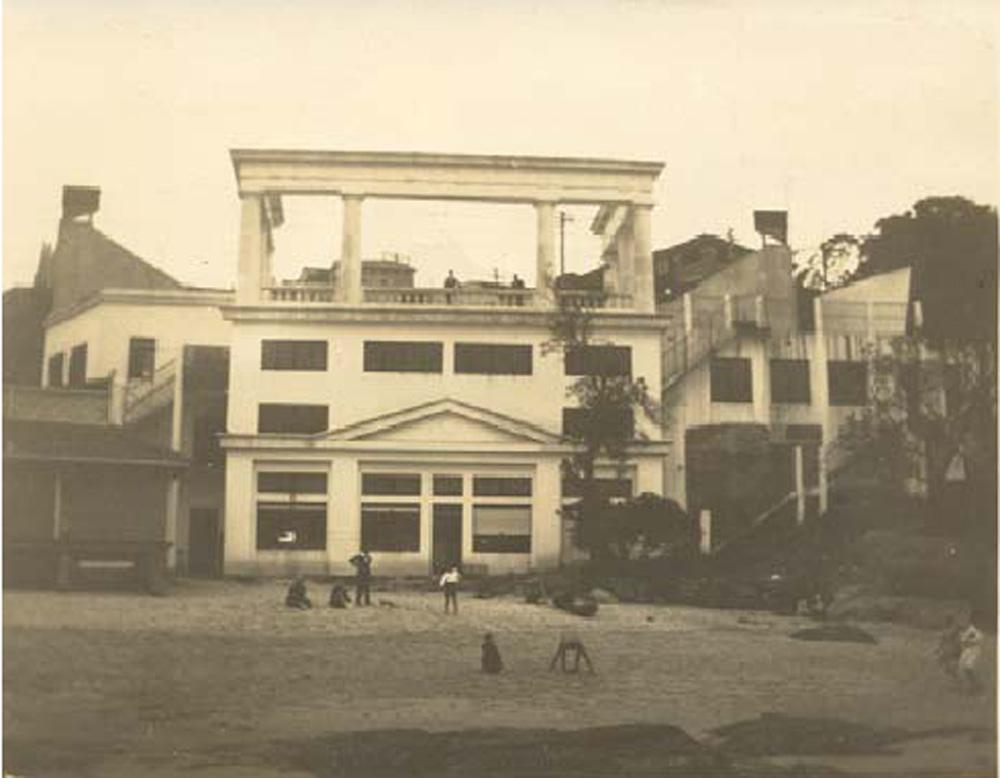
The most striking physical expression of this vision was the Star Amphitheatre at Balmoral. While strictly speaking it sat just outside the North Sydney municipal boundary in Mosman, the Theosophical networks that sustained it were thoroughly North Shore networks. Constructed between 1923 and 1924 by the Order of the Star in the East (a Theosophical offshoot), the amphitheatre could accommodate several thousand people and occupied a commanding site overlooking Sydney Harbour. Beneath its monumental Grecian façade were meeting halls, a library, meditation rooms and other facilities intended to support the spiritual life of the movement. The structure was conceived as a gathering place for followers awaiting the emergence of the new “World Teacher.”
The amphitheatre’s existence reflected the ambitions of the Order of the Star in the East, an organisation founded by Annie Besant and Leadbeater to prepare the world for the expected teaching mission of Krishnamurti. Leadbeater had identified Krishnamurti as a potential vehicle for the coming World Teacher while in India, and throughout the 1910s and 1920s the Order mobilised international networks of supporters in anticipation of this event. Australia became one of the movement’s strongest centres, and the construction of the Star Amphitheatre demonstrated the confidence, resources and organisational capacity of local Theosophists. Yet the project also revealed the movement’s fragility. In 1929 Krishnamurti dissolved the Order, rejecting the messianic role that had been prepared for him, and the amphitheatre soon lost its original purpose.
For the purposes of this essay, the significance of Theosophy lies in its role as a cultural and organisational nexus. The movement connected North Sydney and the wider North Shore to international networks extending from London and Adyar to Melbourne, Sydney and beyond. It attracted individuals interested in spiritual experimentation, educational reform, psychical research and alternative forms of religious life. Many of the personalities examined in the following pages operated within, alongside, or in reaction to this Theosophical milieu. Consequently, Theosophy provides an essential framework for understanding the development of esoteric culture in North Sydney during the early twentieth century. It transformed the district from a suburban locality into one of the most significant centres of alternative spirituality in Australia and arguably, the world.
Next Part 2 — Esoteric Landscapes: The Griffins and the Spiritual Geography of Castlecrag