by Stephen J. King
Part 3 of 4 in “The Mystic Shore: Alternative Spirituality and Modernity in Early Twentieth-Century North Sydney”
The Viceroy to Baphomet and representative of the Beast 666: Frank Bennett and the Collegium ad Spiritum Sanctum of Crows Nest
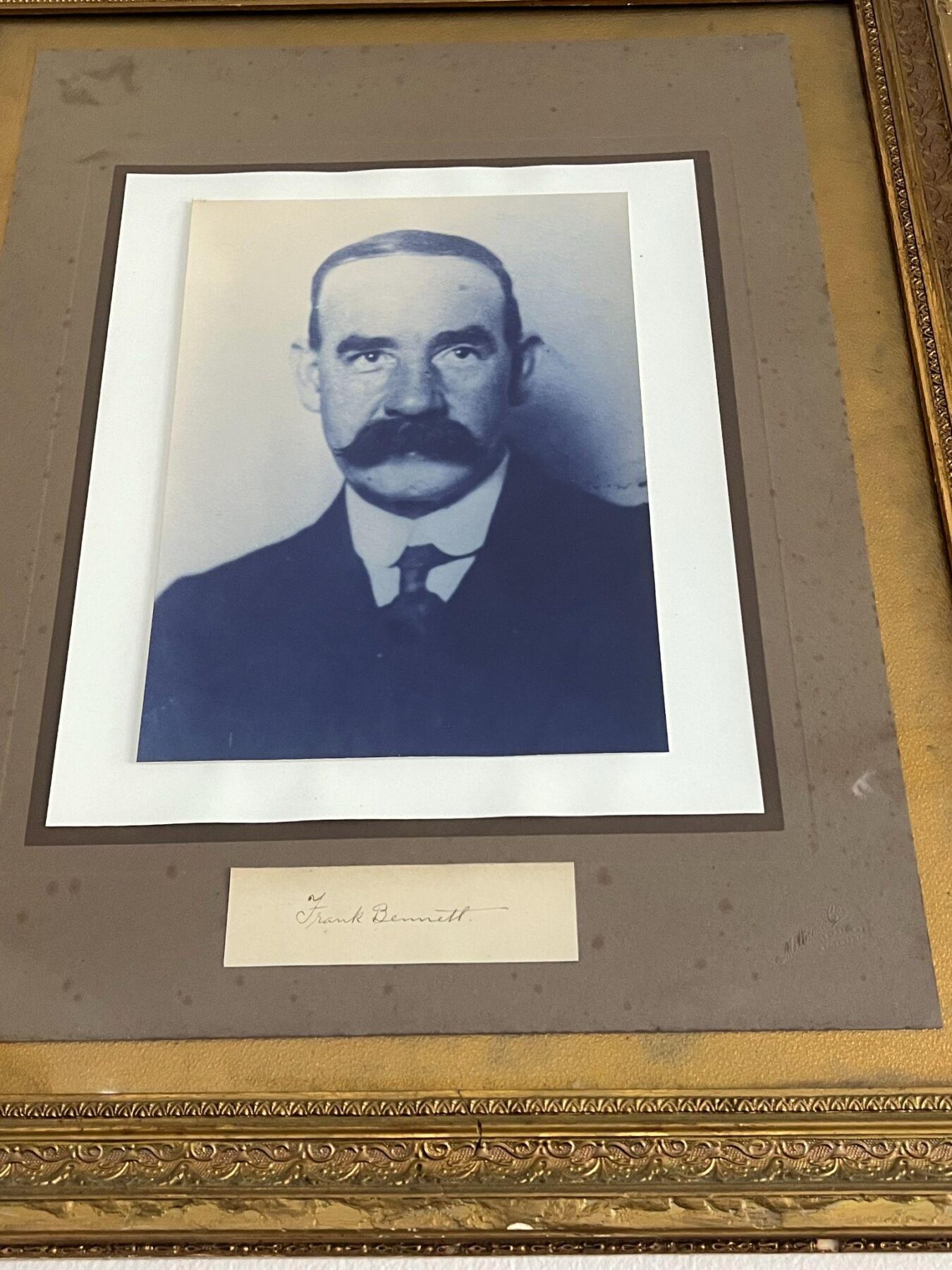
If Theosophy and Anthroposophy represented the respectable face of alternative spirituality on Sydney’s North Shore, a more explicitly occult current could also be found within North Sydney itself. Its principal representative was Frank Bennett (1868–1930), an English-born chemist, Co-Mason and occultist who became the most significant Australian disciple of the controversial British magician Aleister Crowley.
Bennett’s spiritual journey reflected the fluidity of the wider esoteric milieu. Like many seekers of his generation, he passed through a succession of organisations, including the Theosophical Society and Universal Co-Freemasonry, before encountering Crowley’s writings through The Equinox in 1909. Thereafter he joined both the A∴A∴ and the Ordo Templi Orientis (O.T.O.), becoming one of Crowley’s most devoted students. The A∴A∴ functioned as Crowley’s initiatory order for individual spiritual development, while the O.T.O. evolved into an international fraternity dedicated to the propagation of Thelema, the religious and philosophical system that Crowley claimed to have received in 1904 through the revelatory text The Book of the Law. In O.T.O., Crowley adopted the name “Baphomet,” the alleged idol of the Knights Templar.
Central to Thelema was the proclamation of a new spiritual epoch, the “Aeon of Horus,” in which humanity would move beyond the religious forms of the past. Crowley styled himself the prophet of this New Aeon (as The Master “Therion,” or the Beast) and developed an elaborate system of “Magick” intended to facilitate spiritual transformation and the discovery of one’s “True Will.” Unlike the reformist spirituality of Theosophy or the educational idealism of Anthroposophy, Thelema placed considerable emphasis upon ritual practice, initiatory progression and individual mystical attainment.
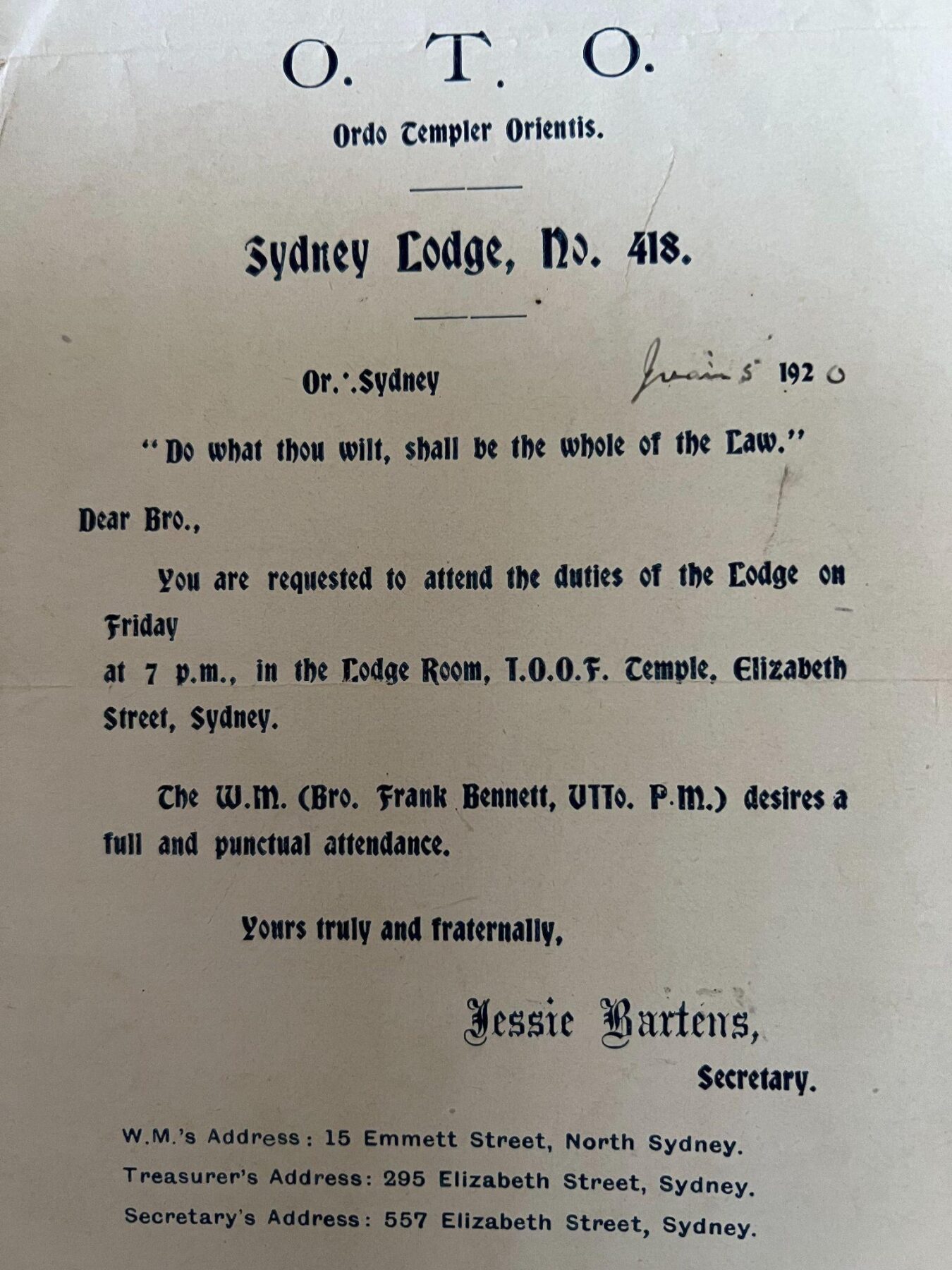
Having emigrated to Australia in 1911, Bennett became instrumental in introducing these teachings to local audiences. In 1915 he received authority from Crowley to establish the first Australian O.T.O. body, the Sydney Rosicrucian Lodge, and spent much of the following decade lecturing, teaching and corresponding with leading figures in the international Thelemic movement. His standing within Crowley’s inner circle was confirmed during a visit to the Abbey of Thelema at Cefalù in Sicily in 1921, where Crowley considered him among his most successful pupils and eventually appointed him his “Viceroy in Australasia.”
By the 1920s Bennett was living at 15 Emmett Street, Crows Nest, a residence to which he gave the grandiose title Collegium ad Spiritum Sanctum (“College of the Holy Spirit”). The name itself is revealing. Unlike the lecture halls, schools and community institutions associated with North Shore Theosophy, Bennett consciously framed his home as an initiatory and magical centre linked to international occult lineages. Although the actual membership of his groups appears to have remained small, the symbolic significance of the Collegium was considerable. Through correspondence, instruction and ritual work, a suburban house in Crows Nest became connected to a transnational network stretching from Sydney to London, Cefalù and North America.
The presence of Bennett in North Sydney demonstrates the remarkable diversity of esoteric culture operating within the district during the interwar period. In neighbouring Mosman, Theosophists constructed the Star Amphitheatre in anticipation of a future World Teacher; at Castlecrag, the Griffins sought to realise spiritual ideals through architecture, landscape and community planning. Bennett’s activities represented a more radical expression of the same wider search for spiritual alternatives. Here the emphasis shifted from education, social reform and philosophical speculation towards ritual magic, occult initiation and direct mystical experience. Yet these developments should not be viewed as entirely separate phenomena. Bennett emerged from many of the same overlapping networks of Theosophy, Co-Masonry and alternative spirituality that characterised the broader North Shore milieu. His career illustrates how the esoteric culture of early twentieth-century Sydney extended across a spectrum ranging from respectable spiritual experimentation to explicitly occult practice.
In 1924 the Sydney newspaper, Smith’s Weekly, ran a series of scandalous expóses on Bennett and O.T.O., describing the Order as a love cult. Under pressure from family, and afraid of losing his job, Bennett withdrew from the public gaze. He frequented the circle of Sydney socialite Dulcie “the Queen of Bohemia” Deamer, where he was lovingly referred to as “the Black Magician.” Deamer recalled, “Good, solid Bennett, with his heavy walrus moustache … Forthright honesty was his middle name … a pillar of unshakeable, kindly common sense.”
If the Star Amphitheatre symbolised the public aspirations of Australian Theosophy, the Collegium ad Spiritum Sanctum represented its more private and arcane counterpart. Together they reveal the extent to which international esoteric movements had become embedded within the cultural landscape of Sydney’s northern suburbs by the 1920s.
Next: Part 4 — The Great Pretender: Vyvyan Deacon and the Abbey of Thelema at Milsons Point